Back
Back- December 03, 2025
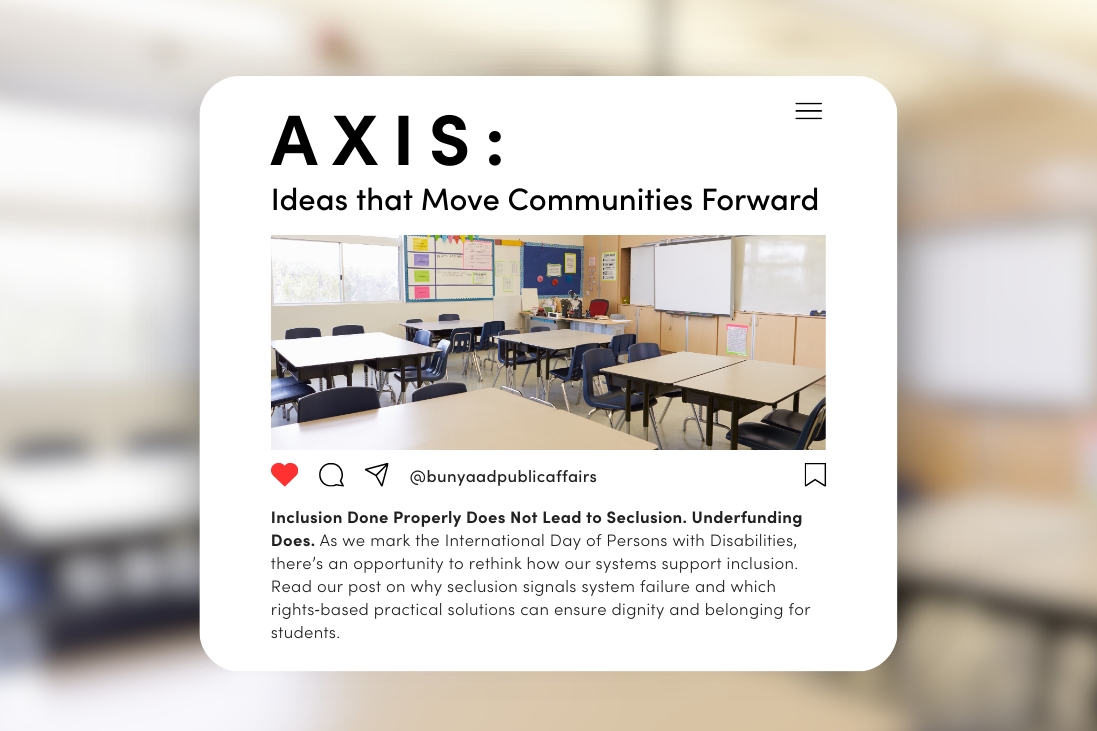
Inclusion Done Properly Does Not Lead to Seclusion. Underfunding Does.
Every year, the International Day of Persons with Disabilities asks us to reflect on the systems we build and how those systems shape the lived experiences of students. In Canada, that reflection requires an honest look at practices that were never intended to be part of inclusive education but emerged as schools absorbed responsibilities far beyond what they were ever designed or resourced to carry. This is not a story about blame. It is a story about what happens when the aspirations of inclusion outpace the investments needed to make it real.
Seclusion rooms did not appear because educators wanted them. They appeared in environments where schools became the default crisis responders for needs once supported through coordinated health, mental health, disability, and social service systems. Behavioural escalation is rarely about intent. It is most often an expression of distress, sensory overload, trauma, communication barriers, or unmet needs. When these needs accumulate without timely support, the options left to adults can narrow in ways that do not reflect their values or their training. Seclusion is not a strategy. It is a signal that the conditions surrounding a student were not aligned with what inclusion requires.
For many parents of children who are profoundly autistic or have high support needs, inclusion has never been a theoretical conversation. They know inclusion can work, but only when it is individualized, stable, predictable, and supported by teams trained in communication, sensory regulation, co-regulation, and crisis prevention. When those conditions are absent, families experience inclusion that is inclusive in name but not in practice. Their advocacy should not be misinterpreted as opposition to inclusion. It reflects their lived reality that inclusion without infrastructure can undermine both safety and learning.
Across Canada, inclusive education remains the goal, and the evidence is clear that when it is properly supported, inclusion improves academic and social outcomes for all learners. The pressure comes not from inclusion itself, but from chronic underfunding, fragmented services, inconsistent access to specialists, and growing mental health and neurodevelopmental needs that schools were never meant to absorb alone. Teachers and educational assistants are navigating classrooms shaped by increasing dysregulation, communication differences, and crisis-level behaviour linked to environmental and systemic factors. Principals are managing operational pressures far beyond the original scope of the role. And despite all of this, educators continue to show extraordinary commitment to students. The system around them has simply not kept pace.
Students with disabilities have inherent rights to dignity, safety, participation, and belonging. These rights do not shift with staffing ratios or budget envelopes. They do not diminish when needs become complex. When a student with a disability experiences isolation or seclusion in a moment of distress, it is not a reflection of who they are or who the adults are. It signals where our system design has not kept pace with our rights commitments. Rights are not aspirational statements. They live in daily routines, in environmental design, in predictable supports, and in training that helps adults respond through understanding rather than containment.
There are evidence-based alternatives already in practice across Canada. Sensory-friendly spaces designed for regulation rather than isolation. Calm rooms used according to clear, transparent protocols. Co-regulation approaches supported by trained teams. Trauma-informed crisis response. Mobile specialists who rotate through schools instead of relying on isolated pockets of expertise. Strong, stable educational assistant staffing supported by ongoing professional learning. Universal design that anticipates diversity rather than reacting to it. These are not theoretical models. They are working examples that show what becomes possible when inclusion is treated as a design challenge rather than a belief statement.
Where the conversation often goes wrong is in reducing these issues to the existence of a room rather than the systems governing its use. The question is not whether designated behaviour-support spaces should exist. Many students, including those who are profoundly autistic, benefit from predictable, sensory-appropriate places to regulate. The issue is that in many jurisdictions, the processes surrounding these spaces are inconsistent or opaque: unclear reporting, variable training, uneven oversight, and no province-wide standards for design or use. That inconsistency erodes trust for families and leaves educators vulnerable to moral distress. The solution is not to eliminate spaces that some students require. It is to ensure that every tool used in a moment of crisis is governed by principled, evidence-based standards applied consistently across the system.
The International Day of Persons with Disabilities reminds us that rights are not symbolic gestures. They are daily experiences shaped by the design of our environments and the integrity of our choices.
For students with disabilities in Canada, honouring this day means creating schools where seclusion becomes unnecessary because the conditions that once produced it have been transformed. When we align our systems with the dignity of every learner, we do more than recognize this day. We make rights real.
And as conversations about seclusion re-enter the political discourse, we would be wise to pay attention to how the narrative is framed. If this suddenly becomes a political priority, the question is whether the focus will centre on student needs or whether it will be used to position local school boards as the architects of failures years in the making and far beyond their control. A sophisticated public conversation requires us to look at the structural contributors in order to understand what is truly happening.
Sherri Moore-Arbour
CEO
BUNYAAD Public Affairs
BackRecent Post
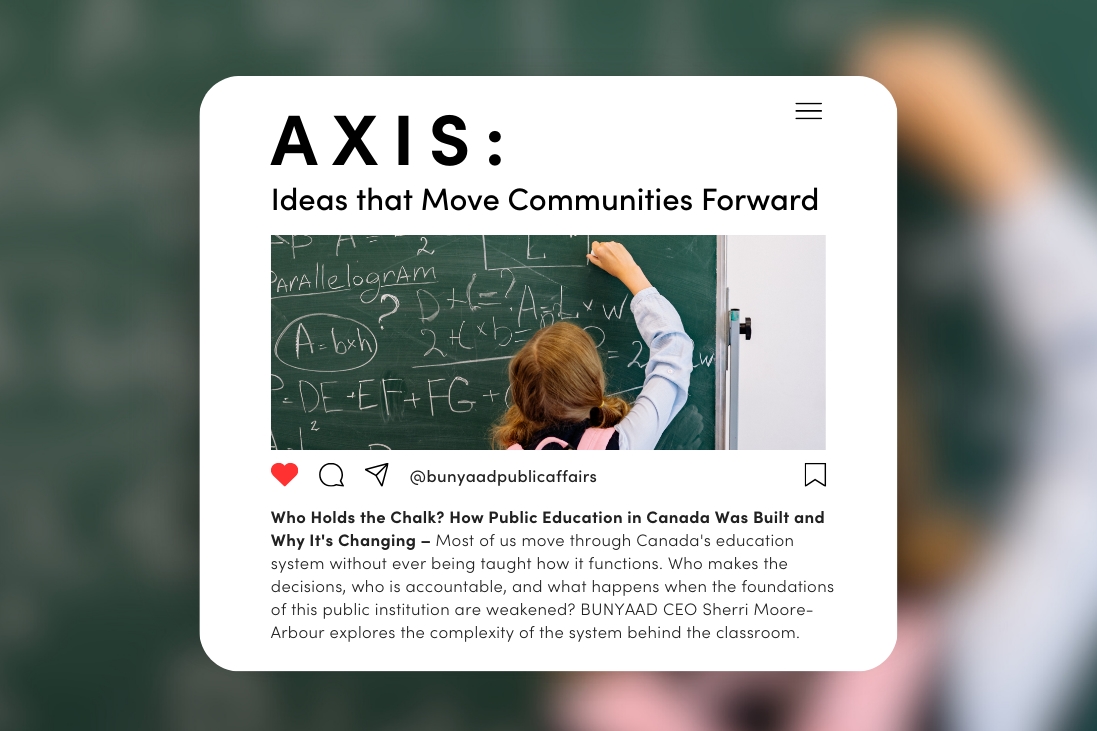
Who Holds the Chalk? How Public Education in Canada Was Built and Why It's Changing
- February 09, 2026
Most of us move through Canada's education system without ever being taught how it functions. Who makes the decisions, who is accountable, and what happens when the foundations of this public institution are weakened?
Beyond the Balance Sheet: Rethinking How We Measure the Carney Budget
- November 04, 2025
As Canada approaches its first federal budget under Prime Minister Mark Carney, the pundit conversation about fiscal policy will inevitably centre on growth, restraint, and balance sheets. But what if we widened the lens? Read the latest post from our CEO, Sherri Moore-Arbour.
 Prev Post